
As global manufacturing automation upgrades accelerate, the demand for efficient and stable palletizing services continues to rise in industries such as food, pharmaceuticals, daily chemicals, and chemicals.
What is Palletizer?
Palletizer is an industrial automation device that automatically stacks finished packaging units such as cartons, bags, drums, and plastic-sealed boxes onto standard pallets according to preset stacking rules. It is widely deployed at the end of production lines and in warehousing.
It is a standard piece of equipment for automating downstream packaging and upgrading intelligent warehousing.
Working Principle of Palletizer
Material Conveying: After the packaging line completes box sealing/sealing, the finished product is conveyed to the palletizing station via a conveyor line. Photoelectric sensors detect when the material is in place.
Organization and Positioning: The material is positioned using steering and alignment mechanisms to ensure the arrangement accuracy meets the palletization requirements.
Grabbing/Grouping: Mechanical palletizers group entire layers of material; robotic palletizers use grippers to grab single or multiple pieces of material.
Stacking: Following a preset palletization program, materials are precisely placed into the corresponding positions on the pallet, stacking layer by layer.
Empty pallets are automatically replenished, and the operation is cyclical.
Types of Palletizer
Traditional Mechanical Palletizing Machines
Mechanical palletizing machines are mainly divided into two categories
High-Level Palletizer
Also known as layered palletizing machines, these are the mainstream solution for mass production scenarios. Materials are transported to a high-level grouping platform via an inclined conveyor, arranged layer by layer, and then placed stably onto pallets in one go, stacking layer by layer.
Gantry/Cartesian Coordinate Palletizer
Utilizing an X/Y/Z three-axis linear guide structure, the gripper moves linearly along the track to complete the stacking. Repeat positioning accuracy can reach within ±0.5mm, and it has a strong load capacity.
Core Advantages: High structural rigidity, high load capacity, and stable precision, suitable for large-size and heavy materials.
Applicable Scenarios: Heavy-duty palletizing scenarios in building materials, heavy industry, and bulk materials.
Robotic Palletizer
Robotic palletizing machines use multi-joint robotic arms as the main body, equipped with dedicated end effectors. Through program control, they complete gripping, shifting, and stacking actions. They are currently the mainstream solution for flexible manufacturing scenarios and are mainly divided into two categories:
Four-Axis Dedicated Palletizing Robots
The mainstream model on the market, with an articulated structure optimized for palletizing scenarios. The working range covers circular workstations and can simultaneously connect to multiple conveyor lines and handle multiple workstation pallets.
Core Advantages: Highly flexible, quick changeover, small footprint, capable of handling complex pallet shapes and mixed palletizing needs
Applicable Scenarios: Food, daily chemical, and pharmaceutical industries with multi-SKU mixed-line production and frequent product specification changes
Six-Axis Articulated Palletizing Robot
With higher joint freedom, it can perform complex movements such as flipping and tilting, adapting to palletizing needs for irregularly shaped materials and special pallet shapes. In some scenarios, it can also handle composite processes such as depalletizing and loading/unloading.
Core Advantages: Flexible movement, highly adaptable, and capable of handling complex workstation layouts
Applicable Scenarios: Irregularly shaped packaging, precision products, and high-end manufacturing scenarios requiring multiple composite processes
Collaborative Palletizer
A lightweight category that has rapidly emerged in recent years. It allows for human-robot collaborative operation without safety barriers, offering flexible deployment and simple operation.
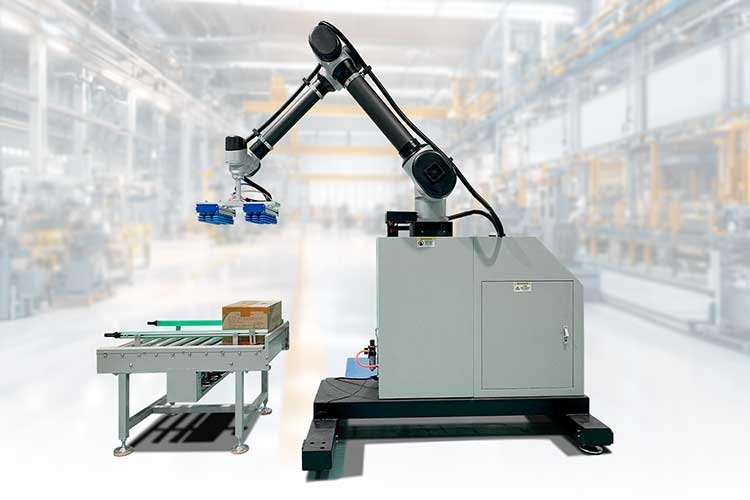
Core Components of Palletizer
Actuating Mechanisms: Robotic arms/gantry cranes, end effectors, and lifting mechanisms, responsible for material handling and stacking.
Conveying Systems: Feed conveyors, pallet conveyors, and grouping mechanisms, responsible for the flow of materials and pallets.
Control Systems: PLC main control unit, HMI human-machine interface, and stacking programming software, serving as the “brain” of the equipment.
Detection and Sensing Systems: Photoelectric sensors, position sensors, and vision inspection units, ensuring positioning accuracy and operational safety.
Safety Protection Systems: Safety light curtains, emergency stop units, and protective fences, complying with industrial safety standards.
Advantages of Palletizer
Significantly Increased Production Efficiency
Automated palletizing machines can operate continuously for 24 hours, with high-speed models reaching over 1000 pieces/hour, increasing capacity by 2-3 times and directly boosting the output of the entire production line.
Stable Stacking, Reduced Damage
Manual palletizing is prone to skewed stacking and misalignment, making it susceptible to collapse and damage during transportation. Palletizing machines stack precisely according to preset algorithms, minimizing alignment errors between layers and resulting in compact and regular stacks, significantly reducing damage rates during warehousing and transportation and improving logistics safety.
Reduced Labor Costs and Safety Risks
Palletizing is a high-intensity, repetitive task, prone to occupational injuries to the waist and shoulders, and there is also a risk of injury from falling heavy objects. The introduction of palletizing machines can replace 2-4 palletizing workers on a single production line, significantly reducing labor costs and workplace injury risks in the long run, thus addressing the global trend of labor shortages and rising labor costs.
Adapting to Flexible Manufacturing Upgrades
Robotic palletizing machines can quickly switch programs and grippers to adapt to various product specifications and pallet types, supporting mixed-line production of multiple SKUs. This allows for rapid response to changes in market orders and aligns with the flexible production transformation of the manufacturing industry towards small-batch, multi-variety production.
Application Industries of Palletizing Machines
Food and Beverage Industry
Adaptable to various packaging formats such as cartons, bags, bottles, and cans, handling products like grains, oils, snacks, beverages, and frozen foods, meeting the hygiene requirements of the food industry.
Pharmaceutical and Daily Chemical Industry
For products with neat and precise packaging requirements, such as medicine boxes, health products, toiletries, and cosmetics, achieving high-precision palletizing and ensuring the integrity of the product packaging.
Chemical and Building Materials Industry
Handling heavy and dusty materials such as chemical powder bags, paint buckets, and building material boards, replacing manual contact with hazardous materials, significantly improving operational safety, with a load capacity of hundreds of kilograms.
E-commerce and Logistics Warehousing
Deployed in warehousing and sorting/outbound processes, completing pallet stacking and depalletizing of full-case goods, improving warehousing turnover efficiency, and adapting to the multi-category, high-frequency operation characteristics of the logistics industry.
Home Appliance and Electronics Manufacturing
Handling finished home appliance boxes and electronic component boxes, ensuring precise stacking to prevent product damage and meeting the high-volume outbound shipping demands.
How To Choose The Right Palletizer?
To match your own production scenario, product characteristics, and capacity requirements, focus on six key dimensions:
Production Capacity and Cycle Time Requirements
For single, high-volume, high-cycle production, high-bay palletizers are preferred; for multi-variety, medium-capacity production, four-axis robotic palletizers are preferred; for small-batch, high-flexibility production, collaborative palletizers are an option.
Materials and Packaging Forms
Bagged materials are best suited for bag grippers or high-bay palletizers; cartons can use vacuum suction cups or clamp grippers; drums and irregularly shaped materials require customized clamps. Material weight, dimensions, and outer packaging material must be confirmed to prevent slippage or packaging damage.
Site Space Conditions
In scenarios with limited factory height and compact workstations, robotic palletizers with a small footprint are preferred; in scenarios with ample factory space and a fixed production line layout, high-bay palletizers can be used.
Pack Types and Mixed Palletizing Requirements
For single standard stack types, mechanical palletizers are suitable; for staggered stacking, mixed palletizing, and multi-SKU co-production, robotic palletizing solutions are essential.
Budget and Maintenance Costs
Mechanical palletizers have relatively low procurement costs and are simple to maintain; robotic palletizers have higher procurement costs but are more flexible and have greater upgrade potential, requiring comprehensive evaluation based on the long-term investment return cycle.
Compliance and Adaptability
The food and pharmaceutical industries need to confirm that the equipment’s hygiene level and cleanliness meet local industry standards; exported equipment needs to confirm safety certifications such as CE and UL in the corresponding regions to ensure compliance.
Conclusion
Choosing a palletizer is not just about purchasing a piece of equipment; it’s about upgrading production line efficiency, logistics systems, and long-term competitiveness. As global manufacturing automation continues to improve, palletizers will evolve towards greater intelligence, flexibility, and ease of deployment, becoming a standard component of factory automation upgrades.