
Traditional relay-controlled packaging equipment can no longer meet the flexible and intelligent demands of modern production. PLC control systems, as a core technology of industrial automation, are key to driving performance upgrades in packaging machines and solving industry pain points.
Definition of PLC Control System
PLC control system is a digital electronic system designed specifically for harsh industrial environments. It stores operating instructions in a programmable memory and integrates functions such as logic operations, sequential control, motion control, data acquisition, and communication transmission, thereby achieving automated, closed-loop, and intelligent control of various electromechanical equipment.
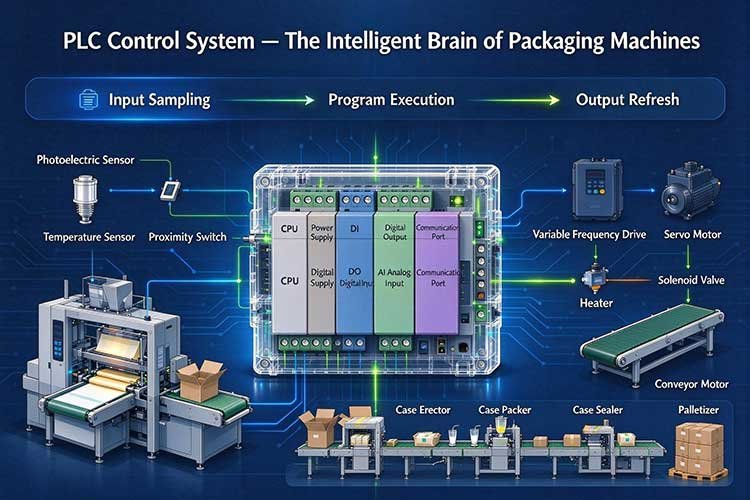
PLC Control System Working Principle
Input Sampling Phase: The system reads the status of all connected input devices (such as sensor signals and switch on/off states) in batches and stores the data uniformly in the input image register. This data remains unchanged within the current cycle regardless of external signal variations.
Program Execution Phase: The CPU executes logical operations sequentially from top to bottom and left to right according to the user-written control program. The results are stored in the output image register.
Output Refresh Phase: At the end of the scan cycle, the system transmits all results from the output image register to the output interface at once, driving external actuators to complete the corresponding actions.
Core Components of a PLC Control System
CPU (Central Processing Unit)
As the “brain” of the system, the CPU is responsible for receiving user-written control programs, executing logical and mathematical operations, diagnosing system faults, coordinating the work of internal components, and ultimately outputting control commands to external devices. The CPU’s processing power directly determines the system’s response speed and the control complexity it can handle.
Input/Output (I/O) Interface Modules
I/O modules are the “nerve endings” connecting the PLC to the production floor:
Input interfaces use optocoupler technology to convert signals from field devices such as sensors, buttons, and limit switches into standard electrical signals that the PLC can recognize;
Output interfaces convert the CPU’s calculation results into power signals to drive actuators such as contactors, solenoid valves, frequency converters, and servo motors to complete actions.
Power Supply Module
Provides a stable DC operating voltage (typically DC24V) for the entire system. Some high-end models are equipped with redundant power supply designs, allowing seamless switching during power fluctuations to ensure continuous system operation and avoid production interruptions and material losses due to power outages.
Storage Module
Divided into two categories: system memory and user memory. System memory stores the PLC’s underlying operating program and cannot be modified arbitrarily. User memory stores the field control logic written by engineers, typically using electrically erasable E2PROM chips, supporting persistent program storage and easy modification.
Programming Device
As a “bridge” for human-machine interaction, the programming device allows engineers to develop, debug, monitor, and upload/download control programs using various programming languages such as ladder diagrams, function block diagrams, and structured text. Mainstream programming software also has auxiliary functions such as fault diagnosis and data monitoring.
Communication Module
Supports data interaction between the PLC and touch screens, host computers, other PLC devices, and management systems such as MES/ERP. It is a core component for upgrading from single-machine automation to whole-line digitalization and networked collaborative automation.
Applications of PLC Control Systems
Packaging Machinery
PLC controls the timing, servo positioning, temperature and pressure regulation of each workstation in packaging machinery, supporting multiple formula storage and one-click model changeover.
Automotive Manufacturing
Applied to all processes including stamping production lines, welding robot workstations, painting and electrophoresis lines, and final assembly conveyor lines.
Machine Tools and Metal Processing
Provides logic control and auxiliary motion control for CNC lathes, machining centers, stamping machines, bending machines, laser cutting machines, etc.
Electronics and Semiconductor Manufacturing
Used in high-precision equipment such as SMT placement machines, insertion machines, AOI inspection equipment, and wafer transfer equipment, achieving microsecond-level timing control through millisecond-level scan cycles.
Intelligent Logistics and Warehousing
Controls stacker cranes, roller/belt conveyors, cross-belt sorters, AGV/AMR scheduling systems, and automatic palletizing equipment in automated warehouses, enabling automatic storage, retrieval, sorting, handling, and traceability of goods, significantly improving logistics turnover efficiency.
Why is the PLC control system so important for packaging machines?
Precise Control Throughout the Entire Process
Packaging processes demand extremely high precision. From filling volume and sealing temperature and pressure to label positioning and cutting dimensions, even the slightest deviation in any step can result in defective products.
Flexible Production Adaptability
The personalized demands of the consumer market are driving the packaging industry towards a “multi-variety, small-batch” model. Changing production on traditional packaging machines requires readjusting the mechanical structure and modifying hardware wiring, taking 30-60 minutes per changeover, severely impacting effective production time.
Improved Operating Efficiency
The millisecond-level scan cycle of a PLC can precisely match the timing requirements of high-speed packaging, ensuring stable high-speed operation of the equipment for extended periods.
Adaptable to Complex Production Environments
Designed specifically for industrial environments, the PLC employs a ruggedized hardware structure, opto-isolation technology, and anti-interference circuitry. It can operate stably in environments with wide temperature ranges, high humidity, and strong electromagnetic interference, achieving a mean time between failures (MTBF) of tens of thousands of hours.
Digital Integration Capabilities
The PLC control system has rich communication interfaces and protocol support, which can easily connect to host computers, MES production execution systems, ERP enterprise resource planning systems, and cloud monitoring platforms.
Conclusion
With the development of the Industrial Internet and intelligent manufacturing, PLCs are also upgrading from stand-alone controllers to digital nodes in factories, combining communication and data capabilities to continuously expand application boundaries and support the intelligent transformation of various industries.